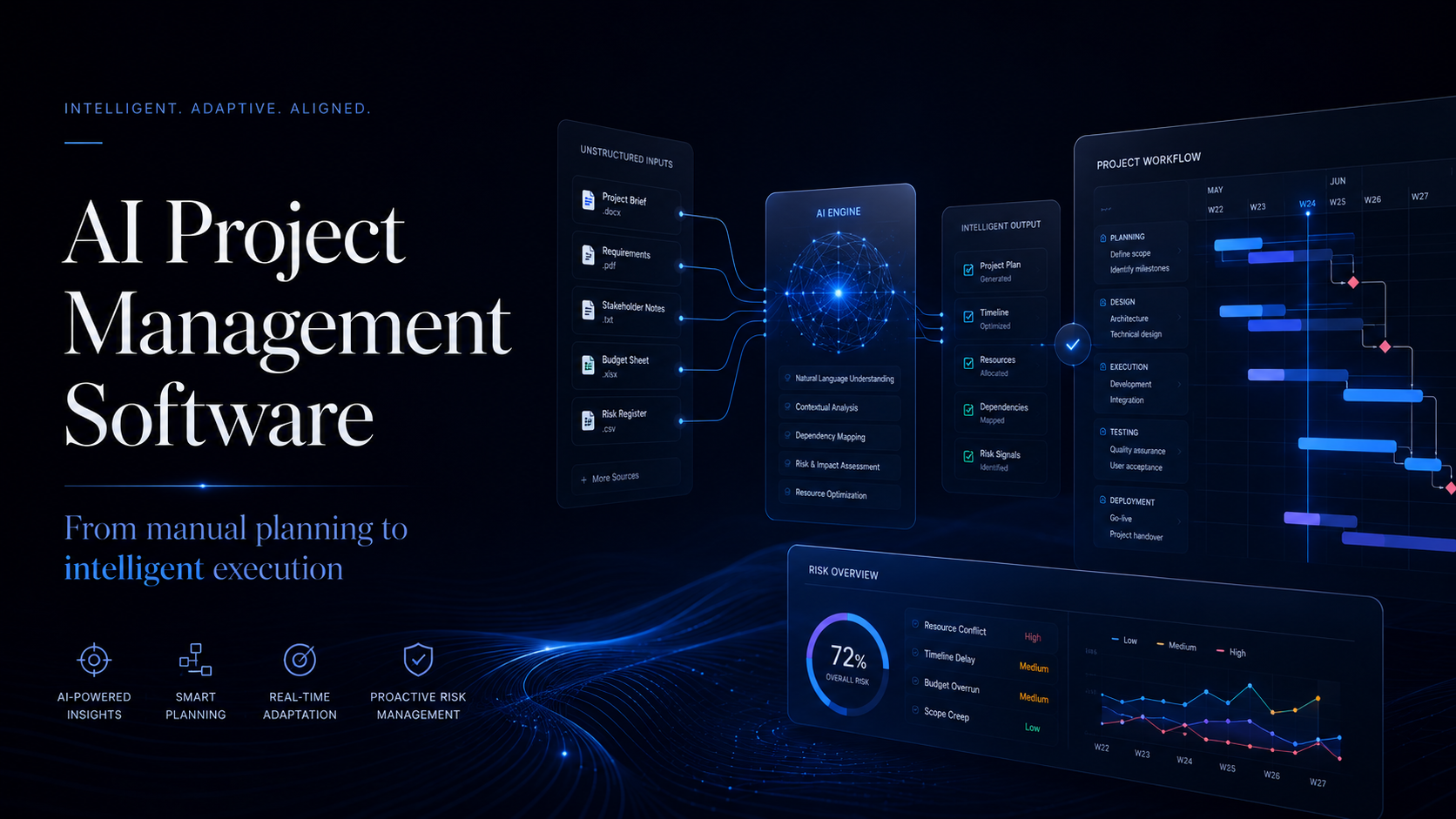
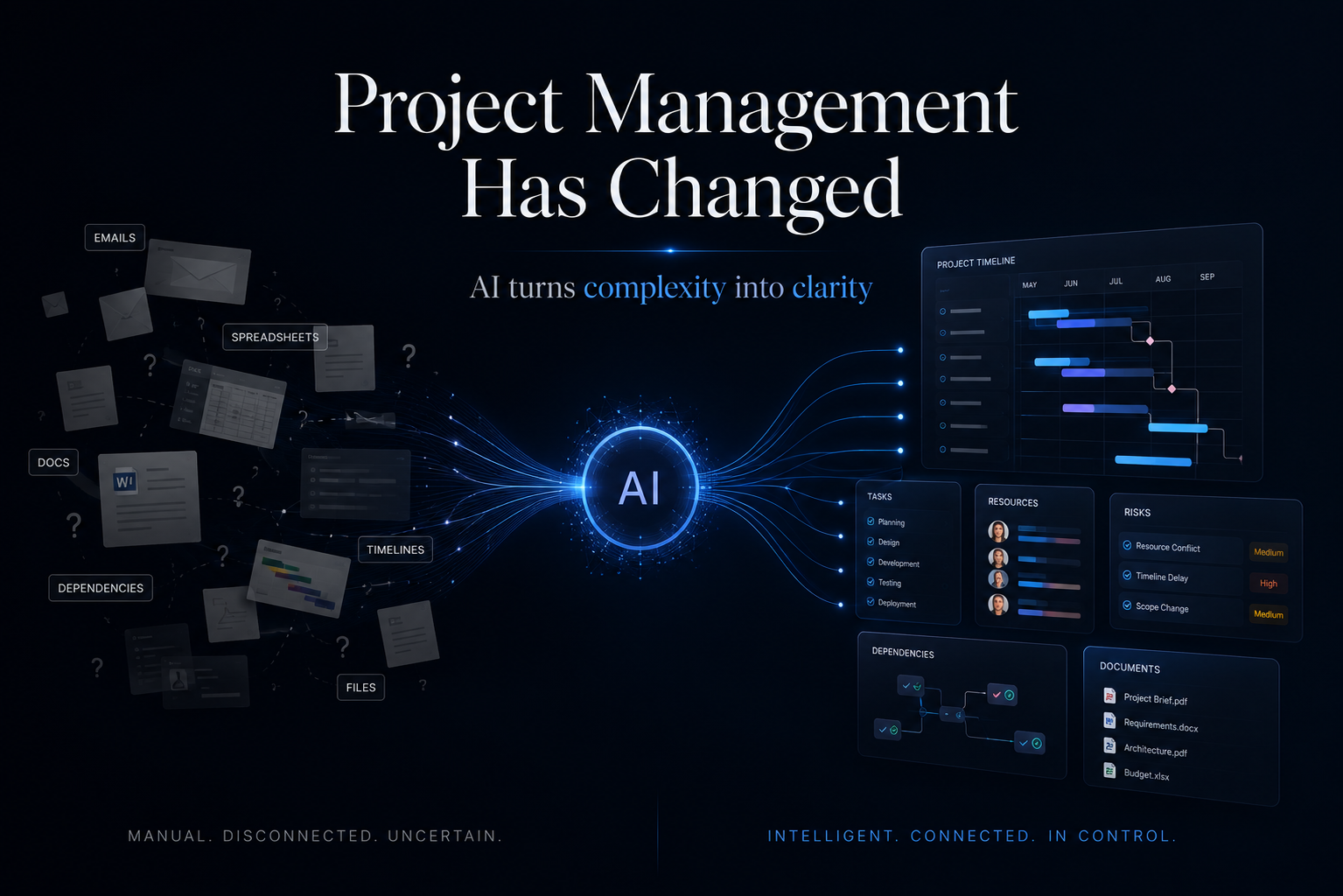
Project management has always been about balancing three critical elements: time, resources, and uncertainty. But as projects become larger, teams become more distributed, and delivery expectations continue to rise. This is where traditional project management methods are struggling to keep pace.Manual planning, endless document reviews, dependency tracking, and risk assessments often consume days before a project even begins. AI project management software is transforming the way modern teams work.
As we employ artificial intelligence to analyze project requirements, automate planning, identify risks, and optimize resources, AI-powered project management tools help organizations move from manual coordination to intelligent execution.
APMA is our tool that takes this transformation further by converting Statements of Work (SOWs) into structured, risk-aware project plans within minutes. The tool is specially built for consulting firms, agencies, and enterprise operations teams. APMA replaces days of manual analysis, dependency mapping, and timeline creation and helps teams achieve faster project starts, proactive risk detection, and smarter resource allocation across multiple projects.
Core Capabilities: What APMA Actually Does
APMA's platform is built around four core capabilities that address the exact pain points teams face:,
SOW Analysis & Auto-Generated Plans
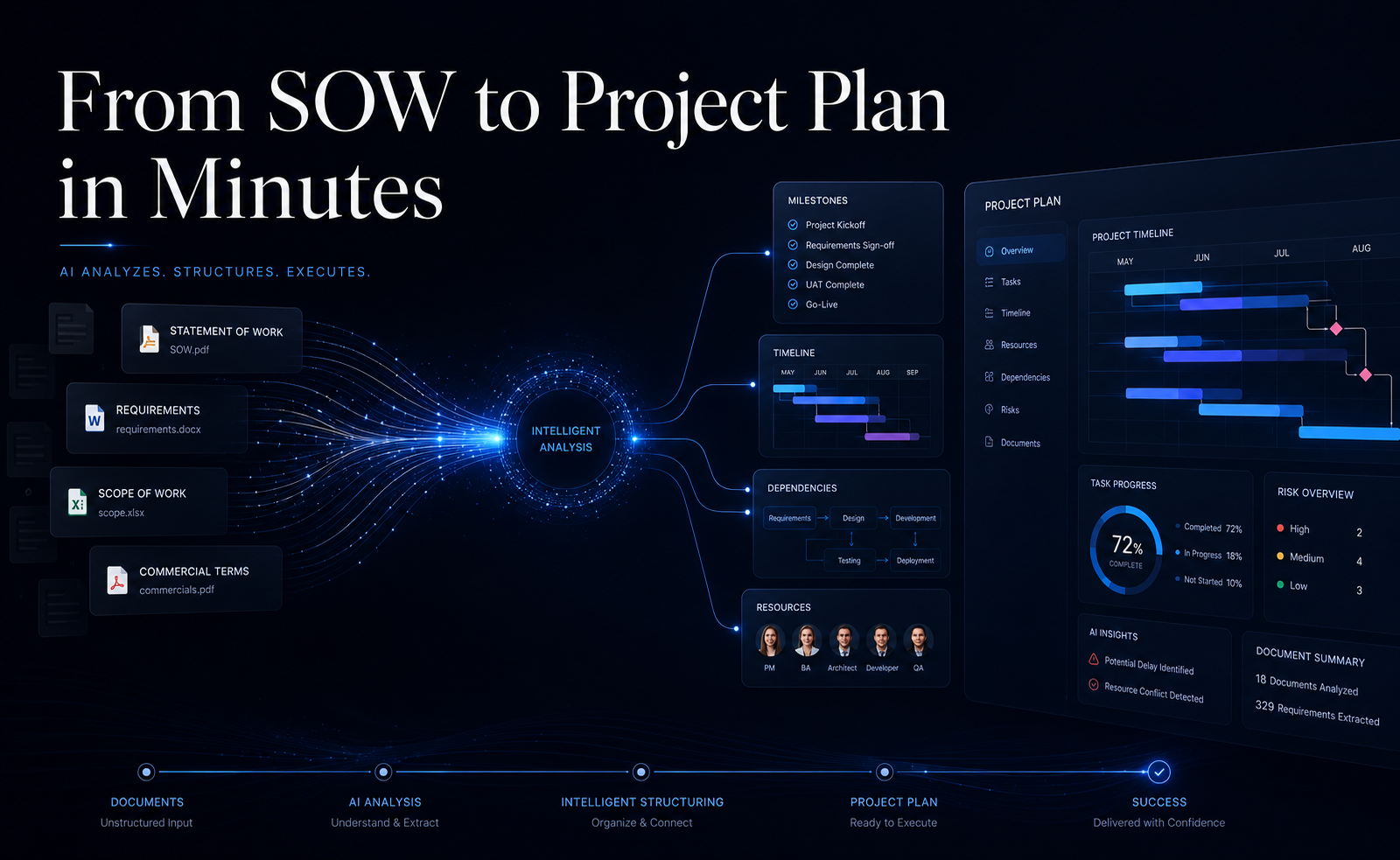
The first step in any project is understanding what you actually need to deliver. APMA's AI parsing technology reads SOW documents,. including the fine print nobody has time to digest, and extracts the critical information: deliverables, timelines, milestones, success criteria, and dependencies.
Instead of your team manually recreating this in a project management tool, APMA automatically generates structured project plans. Timelines are built in. Task sequences are mapped. Dependencies are flagged. You're not starting from scratch anymore; you're starting from a complete, AI-validated blueprint.
For teams that currently spend 5-10 hours analyzing each SOW, this alone saves weeks of work every month.
Meeting Items to Automated Tasks
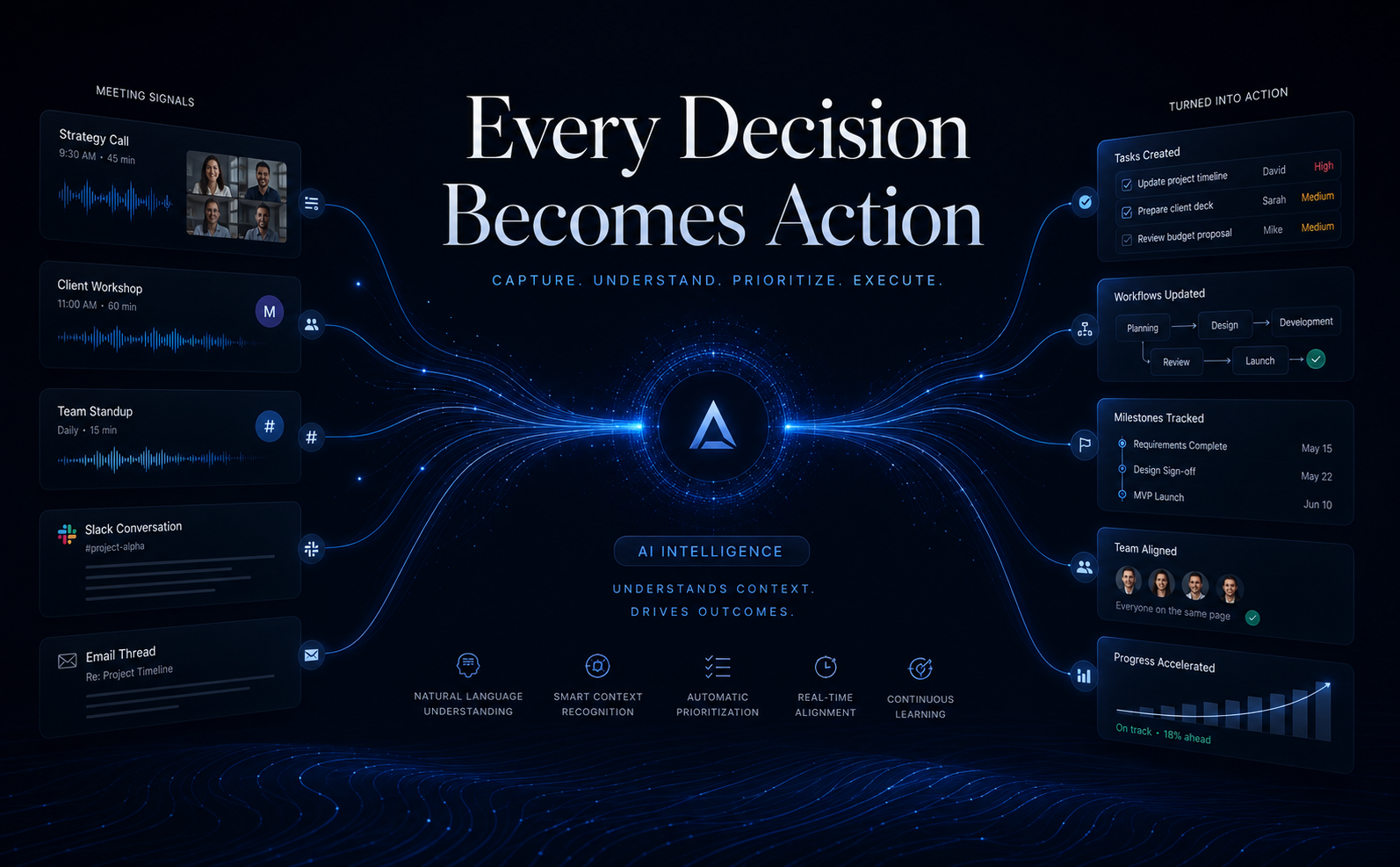
How many times have you heard "can you send me that action item from the meeting?" only to discover it somehow got lost between Slack, email, and someone's notebook? APMA eliminates this friction by automatically converting meeting outputs into project tasks. Your team discusses priorities, decisions get made, and they're instantly captured in the project plan. No manual transcription. No items falling through the cracks.
Change Order Automation
Here's where most tools fail: they don't prevent scope creep. APMA actively fights it. When a client requests changes (and they always do), our ai project management software automates the change order process. It analyzes the impact, which tasks are affected, how the timeline shifts, what resource reallocations are needed, and surfaces this intelligence to the right people for approval. Scope creep becomes visible and manageable instead of a silent budget killer.
Resource Optimization
Poor resource allocation is one of the biggest reasons projects fail. APMA analyzes your team's skills, availability, and current workload across all projects, then recommends optimal task assignments. It identifies when someone's overbooked. It flags capacity issues before they become crises. For operations leaders managing dozens of concurrent projects, this is invaluable.
The Business Impact: Real Numbers From Teams Using APMA
Let's talk about what this means in actual business terms:
Let's talk about what this means in actual business terms:
| Challenge | Traditional Approach | With APMA |
|---|---|---|
| Planning time per SOW | 6-10 hours | 1-2 hours |
| Risk identification | Reactive (found during execution) | Proactive (before kickoff) |
| Scope creep management | Manual tracking | Automated alerts & impact analysis |
| Resource conflicts | Discovered mid-project | Identified before assignment |
| Planning accuracy | 70-80% | 95%+ |
| Team visibility | Siloed information | Complete, real-time transparency |
For a mid-sized consulting firm managing 30 active projects, moving to APMA means:
- 760+ hours saved annually on planning and analysis
- Scope creep reduced by 40-60% through proactive detection
- Resource utilization improved by 25-35% through intelligent allocation
- Client satisfaction scores up because projects stay on track and on budget
Who Wins Most With AI Project Management Software.
APMA's platform was purpose-built for specific types of teams:
Consulting Firms & Agencies benefit immediately. Every project starts with a SOW. APMA analyzes them faster, more consistently, and more thoroughly than any human team. This means faster client kickoffs, standardized quality, and better margins.
Project Managers get their time back. Instead of spending half your day in meetings explaining status and fighting fires, you're proactive. APMA gives you early warnings about risks. You guide your team toward solutions instead of scrambling to fix problems after they happen.
Enterprise Operations Teams gain portfolio-level visibility. When you're managing 100+ concurrent projects across multiple teams, you need data-driven decisions, not intuition. APMA provides that foundation.
In-house Teams with Complex Projects (product teams, development, internal operations) find that automated project management software eliminates the friction that slows down execution.
Beyond The Basics: Advanced Capabilities
APMA goes deeper than simple task tracking:
- Dependency Mapping: Complete visualization of how every task connects, so you catch cascading delays before they happen
- Risk Alerts: Built-in detection flags scope creep, missing information, capacity conflicts, and timeline risks
- Portfolio Visibility: See all projects at once, understand resource availability, and make data-driven allocation decisions
- Integration Ready: Works with your existing stack, Slack, email, calendar integrations mean less context switching
- Continuous Learning: The more you use APMA, the better it understands your organization's patterns and preferences
The Comparison: Why APMA Outperforms Generic Project Management Tools
Most project management tools are generic. They assume every project is the same. They require extensive manual setup. They're responsive rather than proactive. APMA is purpose-built for complexity:
The difference isn't subtle. It's the difference between a tool that helps you manage projects and a tool that fundamentally changes how you execute them.
Pricing That Works for Teams of Any Size
APMA offers straightforward, one-time licensing:
- SMB Plan ($4,499): Perfect for smaller teams and consultancies starting to scale.
- Growth Plan ($6,499): Multi-team access with advanced reporting and priority support.
- Mid-Market Plan (Custom): Enterprise-grade with dedicated success management.
Unlike subscription models that nickle-and-dime you, APMA's pricing is transparent and predictable. You buy the license once and keep using it.
The best AI project management software in the world doesn't help if implementation is a nightmare. APMA's onboarding is designed to get you value fast:
- Day 1-2: Upload your current SOWs. APMA analyzes them instantly.
- Day 3-5: Your team reviews generated plans and makes adjustments.
- Day 6+: You're live, using APMA for new projects and seeing immediate time savings.
There's no three-month implementation cycle. There's no massive training requirement. Your team learns by doing, and value starts accruing immediately.
The Bottom Line: Your Next Competitive Advantage
The teams winning in 2026 aren't necessarily the ones with bigger budgets or more people. They're the ones executing with clarity, visibility, and speed. These teams are the ones catching risks early instead of scrambling mid-project. They're the ones optimizing resources intelligently instead of hoping for the best.
AI project management software like APMA isn't just making your team's lives easier (though it is). It's fundamentally changing your competitive position. Faster planning means faster client kickoffs. Better risk detection means higher project success rates. Smarter resource allocation means better margins. These aren't small improvements, they're the difference between teams that are perpetually firefighting and teams that are predictably delivering.
If you're still managing projects the way you did five years ago, you're operating with one hand tied behind your back. Your competitors aren't. APMA is built specifically for project-driven teams ready to move beyond manual processes and into intelligent execution. The question isn't whether automated project management software is worth considering anymore, it's whether you can afford to keep operating without it.
Frequently Asked Questions
How long does it take to see ROI with APMA?
Most teams see tangible benefits immediately. Planning time drops by 80% on the first SOW you process. Within 30 days, teams typically save 40-60 hours that would have gone toward manual analysis. Financial ROI usually materializes within 2-3 months when you factor in faster project kickoffs, reduced rework, and better resource utilization.
Is APMA difficult to implement? Do we need extensive training?
No. APMA is designed for immediate adoption. Your team can upload a SOW and generate a project plan on day one. There's no lengthy onboarding, no steep learning curve. Most teams are productive within a few days. The AI does the heavy lifting, your job is just to review, adjust, and execute.
Can APMA work with projects that don't have formal SOWs?
Yes. While APMA's strongest use case is SOW-based projects (consulting, client services, contract work), the platform can also work with RFPs, scope documents, and verbal requirements. The AI adapts to different input formats, though structured documents produce the most comprehensive plans.
How does APMA handle industry-specific project requirements?
APMA works across consulting, software development, marketing, manufacturing, operations, and more. The platform learns your organization's specific patterns, your preferred task structures, typical dependency types, risk factors that matter most. As you use it, it becomes increasingly tailored to how your team operates.
What happens if we already have projects underway? Can we use APMA mid-project?
Absolutely. APMA helps with active projects too, it can help you rebuild plans from existing documentation, identify hidden risks, optimize current resource allocation, and automate change management going forward. You don't need to wait for new projects to start benefiting from the platform.
Is our data secure with APMA?
Yes. APMA uses enterprise-grade security, encryption for all data in transit and at rest, and complies with standard security certifications. Your SOWs and project data remain your pro.